

Among the many remarkable elements of Tiger Woods’ iconic victories, one aspect that continues to stand out is his iron play. Over the years, Tiger’s approach game has remained a benchmark for precision and consistency traits that still resonate in today’s data-driven era of golf. So what makes Tiger’s iron game so effective, even now, as the sport continues to evolve with new technologies and younger talent? In this feature, we break down the core techniques that define his legendary approach play. From ball-striking fundamentals to shot shaping and course management, these are insights every golfer can use to sharpen their own performance from the fairway.
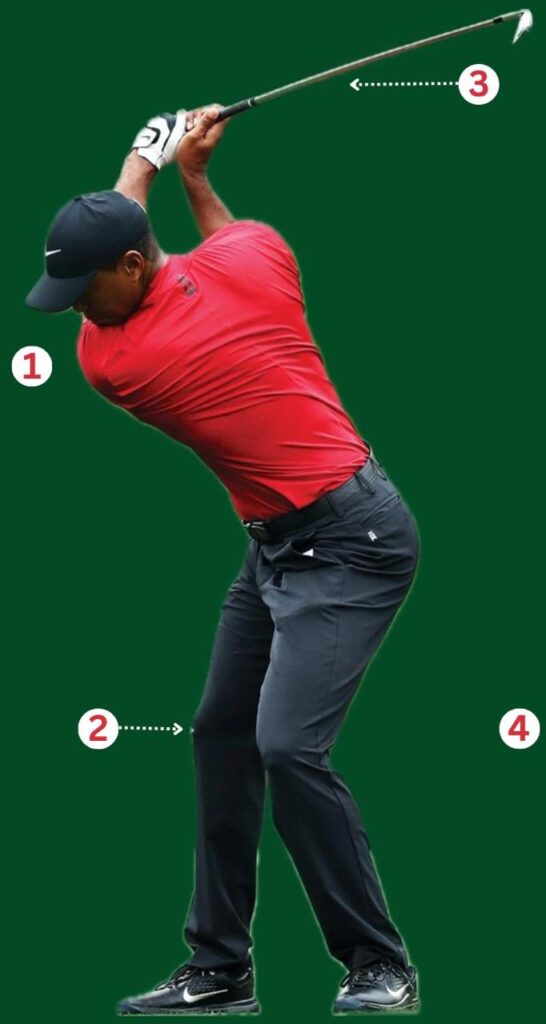
- Full Tilt
Look just how much lower Tiger’s left shoulder is than his right. The tilted nature of this shoulder turn is a direct result of the bent-forward spine angle he has set at address the shoulders are simply turning on a right angle around that pitch. This picture should once and for all put to rest any notion that the shoulder turn in a golf swing is level. - Leg Work
Note how Tiger’s right knee is slightly higher than his left. This indicates a slight straightening of the right leg to facilitate hip turn; it also shows how his right foot is pushing into the ground. Imagine standing on some bathroom scales normally, then increasing pressure under your right foot by pushing down. The leg would straighten a little. That’s what you’re working on here. - Less is More
Take a look at the length of this backswing, and note how the shaft is slightly short of parallel to the ground. To control your irons you need a solid strike, and swinging the club way beyond parallel to the ground is going to make a centred strike difficult. Work on a more compact action, with minimal lateral movement, and you’ll find it easier to control strike point and contact quality. - Great Shape
One of the great things about Tiger’s ironplay is how easily he is able to move the ball either way. We can trace this back to the relationship between his lead forearm and the clubface at the top – their angles match. This is the definition of square, and allows Tiger to either open or close the face with control. Use a full-length mirror to check your face-forearm relationship, and work on it.